David Stewart, chief executive of Zoltek Automotive, speaks to CM Magazine on the growing use of composites.
David Stewart has been working in the automotive industry for over 20 years, taking technology out of labs and applying it to mass production environments. He owns a research firm, Stewart Automotive Research, and was just named chief executive of Zoltek Automotive, a new subsidiary from the carbon fiber supplier.
Zoltek’s CEO is quoted as saying carbon fiber is easier to use in wind energy than automotive. What makes automotive tougher to work with?
The volume requirements involve very different requirements on the manufacturing process. Cycle time is important, and the part geometry is substantially more complex. The chemistry of the curing process for thermosets needs to be tailored to the faster cycle time requirements. For preforming, getting the fibers into the appropriate alignment with the part geometry and structural requirements is a very different process for smaller parts with more curvature as compared to the structural parts in wind blades.
Why did Zoltek form this subsidiary?
The primary factor was renewed interest in automotive composites from the OEMs. Several OEMs have announced production programs where they’ll be delivering production vehicles that utilize lightweight carbon fiber materials. There are a few examples in production right now. In lower volumes, Tesla has carbon fiber body panels; in higher volumes, BMWs are being manufactured with carbon fiber structural and exterior body panel components. It has given some confidence to other OEMs that there’s a place for these materials in low-volume niche manufacturing and higher-volume production applications.
Which American OEMs are more likely to use composites?
That’s a tricky question. They all have equivalent incentives. I can’t comment on any of their individual development programs because of their proprietary requirements. I will say that GM and Ford have the development budgets that allow them to pursue these opportunities. It is worth noting that the latest wave of gasoline price increases and changes in the regulatory environment has led to that renewed interest among the OEMs in composites.
What are some of the biggest challenges OEMs have working with composites?
Composites are a challenge for material substitutions because the technology required to manufacture composites differs so much from the traditional materials they replace. The design and manufacturing infrastructure both change and that makes it challenging for existing capital industries to change over from one material to another. There’s such a huge investment in the existing way of doing things in the engineering, design, testing, quality control, etc.
Why hasn’t the automotive industry embraced carbon fiber more until now?
There’s a long lead time for developing these technologies for high-volume production. A number of efforts in the past have seen a three-year development cycle and a seven-year cycle for re-engineering an entire vehicle platform. Implementing substantial amounts of carbon fiber in the vehicle platform greatly impacts the engineering of the fundamental platform, painting process and crash analysis. Those changes need to be made up front in that development cycle.
Before moving a large amount of vehicle production to an alternative material, there’s a desire to have the material validated in a smaller-scale, less capital-intensive, less risky environment. A lower volume platform is selected initially, which is also a seven-year development cycle. You can get sufficient data to project the warranty costs and performance in an actual service environment. We’ve been through that cycle a few times, but every time when we have incentives from a fuel economy, the price of fuel has gone back down again. That volatility has never provided a sustained incentive to re-engineer vehicle architecture as well as maintaining the variable cost incentives to spend additional money on more expensive materials. Fuel prices need to be at a sustained projected level where the materials pay for themselves over the life of the vehicle.
Are we reaching that point, or will more instability follow?
After so many years, we finally have an increase in the corporate average fuel economy (CAFE) requirements. There is now a hard target that North American manufacturers have to meet. That hasn’t happened since the 1980s. Most manufacturers are projecting the price of oil to remain above $60 a barrel for a sustained period of time going forward.
What difficulties will you face in starting the subsidiary?
We need to establish a solid relationship with a fairly new and changing supply base. Recent difficulties in the auto industry have put most of the Tier 1 suppliers through Chapter 7 or 11 bankruptcies. There are some financially strong suppliers that do composite materials, but it’s always been a fragmented industry with a large number of suppliers and contracts for a fairly small volume of components. The OEMs and Tier 1s started to re-evaluate their relationship and the applications appropriate for the structural composite materials. We need to re-evaluate what that supply chain looks like and what support they’ll need.
What do manufacturers need to get involved in that re-evaluation?
The manufacturers with the largest ability to respond to new demand are those with the greatest investment in capability and design testing and manufacturing process equipment. So it requires a substantial investment. There’s not a lot of existing capacity out there that is drop-in and ready for a significant shift toward lightweight composites.
What does Zoltek see as the future of carbon fiber in medium to large production automotive parts?
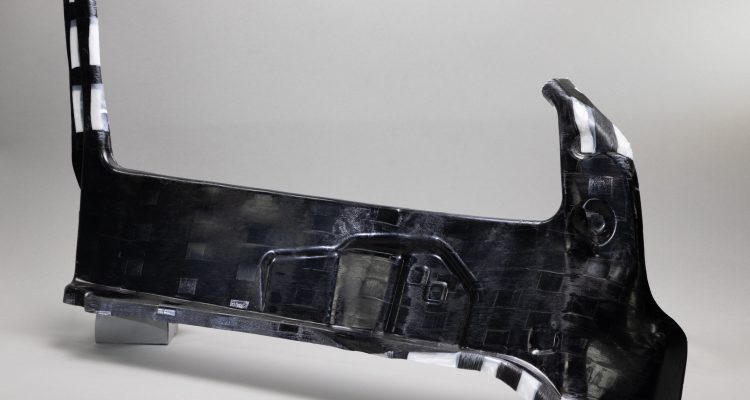
We are most interested in structural components that lend themselves to high-volume manufacturing, compression molding and injection molding. We stay away from components that are painted because of the difficulties in reconciling the painting process with different manufacturing processes. We’re utilizing our material in this fashion, but we think it will remain a niche market from a volume sales standpoint, and by far the largest tonnage of carbon fiber is with the structural and underhood components such as drive shafts, chassis, pillar, brass beams, bumper beams, intake manifold and oil pans.
What production processes will the subsidiary incorporate?
We’re working with our customer base on all volume-capable carbon fiber manufacturing processes. These include preforming, resin transfer molding, compression molding for thermosets and thermoplastics, thermoplastic compounding for short and long fiber reinforced molding compounds, filament winding. If a process doesn’t have an established history, the development cycle for implementation into a high-volume vehicle platform is quite long. We’re focusing most of our efforts around established processes incorporating fiberglass, analogs or filament winding.
How can the industry improve its recycling of carbon fiber to improve its “green” aspect?
There are different ways for evaluating this aspect of end use requirements. It varies from one OEM to another. In Europe, you must identify exactly how this material will be recovered at its end of life. It’s a different question for thermosets and thermoplastics, and we’re working with companies who are developing techniques to reclaim carbon fiber at its end of life and recycle it either as short fiber or milled fiber materials. Over the course of the life of the material, the weight savings more than offsets its cost to produce and cost for end of life recycling.
To subscribe to CM’s weekly Q&A, click here.